Friday, September 30, 2016

9/30/16-Kirk Brown


Today Mr. Rivers was absent (rest his soul), We were aware of this so we were told to work on our essays. For some people that meant different things than it meant for others.  Depending on progress some people finished their books, if it was not yet done, others started their movie others finished their movie in class. If we finished that we were supposed to start brainstorming ideas for our essay comparing the novel to its film. I personally didn't watch my movie The Godfather recently enough to remember much of it so at the start of class I began to watch my movie. When the period had about 10 minutes left I stopped watching the movie because there was something I wanted to compare in the book to how it was in the movie.
In my book the beginning took place in a courthouse , but in the movie the first scene is anything but a court house. However even though the setting wasn't the same or similar it gave the same information as the court room in the book. The man explain the events that lead up to his daughter being beat up to the point where she had to be sent to the hospital. By making this the opening scene this does two things gives a more emotional take on the event where as a judge’s deliverance of information would seem sort of cool and unfeeling. So one it adds emotion, but two is this scene may even give more information about the event the the courthouse scene in the book did. Her father is more likely to know what happened leading up to the event then a judge just reading the claims of a paper. So just from the start of the movie i can see big differences but the differences might work well.
9/30 Michaela K.

Today in class was a sad day, you weren't here. Luckily, we were able to manage in your absence. As soon as class began, everyone went straight to their seats and started working on their computers. Everyone seemed to be doing something different. Today's assignment was to somehow work on your intertextuality essay. There are several ways people could execute this assignment, so in today's class there was not one set activity everyone was doing. Some students finished their book, others put their headphones in and drifted away into their movie. Personally, I already finished my book and film which was Room. So, like some of my peers, I began working on the essay. I started by thinking about the following questions: How is the film different from the novel? How is the film similar to the novel? Do the film/novel do the same things? Do they do them in the same way? These questions are excellent starting points when thinking about how to write your essay. Additionally, I began to answer these questions: What examples are best for an analysis? How does mise-en-scene help you specify your analysis? How can you include an analysis about content and form? Having starting point questions before an essay is very beneficial because it helps you to get organized and help your essay to be clear and specific. In order to get a decent grade on the essay the planning that we did in class is essential. Overall, the class was very laid back today and everyone worked at their own pace. 

Here we are working hard!

Thursday, September 29, 2016

9/29/16 - Sarah Hoffman

Today in class, we talked about expository essays. Mr. Rivers showed us the rubric that he will use to grade our essays that we will write on our summer reading books. He addressed many concerns that I personally have had in the past when it comes to Common Core essay grading. For example, he explained exactly what grading on "Style and Tone" means, even though everyone has their own individual tone. He explained what he wanted to see in the essays, putting particular emphasis on verb usage and the balance between "clear" and "specific" writing. Verb usage is pretty self explanatory; making good use of active verbs. The clarity vs specificity issue was presented like a balance or seesaw. While your writing has to make clear sense and present a clear point, it also has to be detailed and specific enough to prove that point. A balance must be maintained. We finished class with some time to make progress on our essays.

Wednesday, September 28, 2016

9/28/16- Zach Herbert

Today in class we took our summative assessment on mies-en-scene. I felt pretty good about how I did because  Mr. Rivers let us use any notes we had. So I went back and used the PowerPoint that my group made and it helped me very much.  If he didn't let us use or notes I don't think i would have done so well.  In this class period, we didn't do so much just because everyone was focused on getting a good grade, like myself. Normally I would talk about what I did, but that would be technically cheating because then I would be giving some hints to others that have not taken the test. But before the test we went over how the test would be taken and any questions that we had on it Mr. Rivers answered them with ease.

Tuesday, September 27, 2016

9/27 Connor Erickson

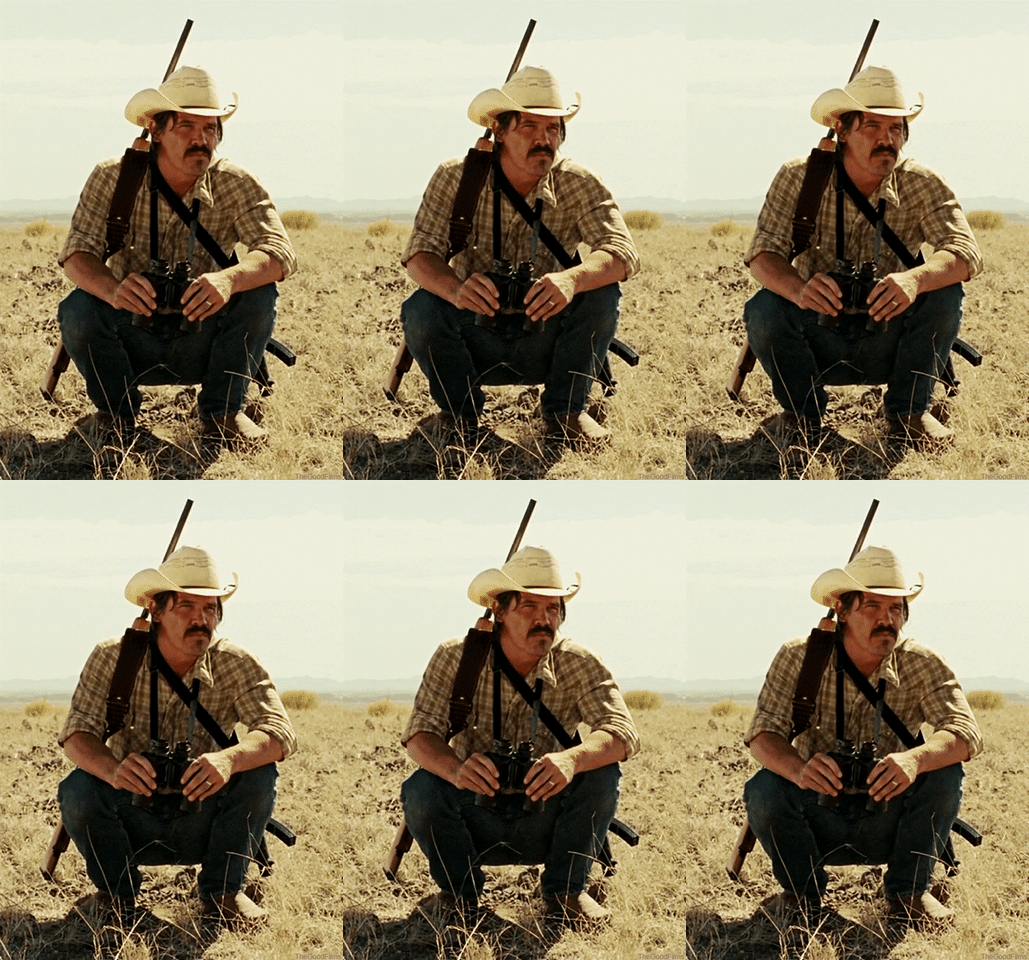
Today in class we continued watching, No Country for Old Men, and started playing the movie just after Moss had been shot. Throughout the entire movie we’ve seen the movie from more of Moss’ point of view than the sheriff but after Moss died it was all from the Sheriff’s point of view and Chirgurh’s point of view. The movie starts today with Moss getting buried and the sheriff going to the crime scene to check things out. As the sheriff goes back to the crime scene, the motel, we as an audience get an eerie and curious kind of feel because we see that the lock has been shot out (the lock being shot out has shown us from past experience with the movie that Chigurh has been there).  But as the film continues the suspense is built up and nothing happens during the scene.  Then after Moss’ funeral, Carla Jean Moss goes back to the house to find that the window is open. She goes into her room and Chigurh is sitting on a chair in the corner just staring at her. As an audience we feel something bad about to happen because of Chigurh’s monotone voice and when Carla Jean Moss tries to talk him out of it he says, “Everyone says that. Your husband had a chance to save you and instead he tried to save himself.” The intense scene goes on and he flips a coin and tells her to choose a side. She tells him no because the coin doesn’t pick what actions you need to take only you do. After an argument back and forth the next scene shows him walking out the house and cleaning his boots (applying the sense that he killed her). He drives away and is hit by another car. He pays a boy on a bike to give him his shirt and that he never saw him. Chigurh leaves the scene with a bone sticking out of his arm. The most important scene was the ending scene that nobody seemed to like. It was the sheriff talking about his dreams (applying the sense that he has ptsd) and the movie ends. As a class we discuss why the directors would want to end the movie that way. Moss is dead, his wife is dead, the sheriff has ptsd, Chigurh left the crime scene with a broken arm, and the Mexicans have the money. We as an audience don’t know anything else and as a class we came to an agreement that the directors want the audience to think and imply the ending. All the suspense built up for an unresolved ending was their intention. 


Monday, September 26, 2016

9/26- Jackie Dowd

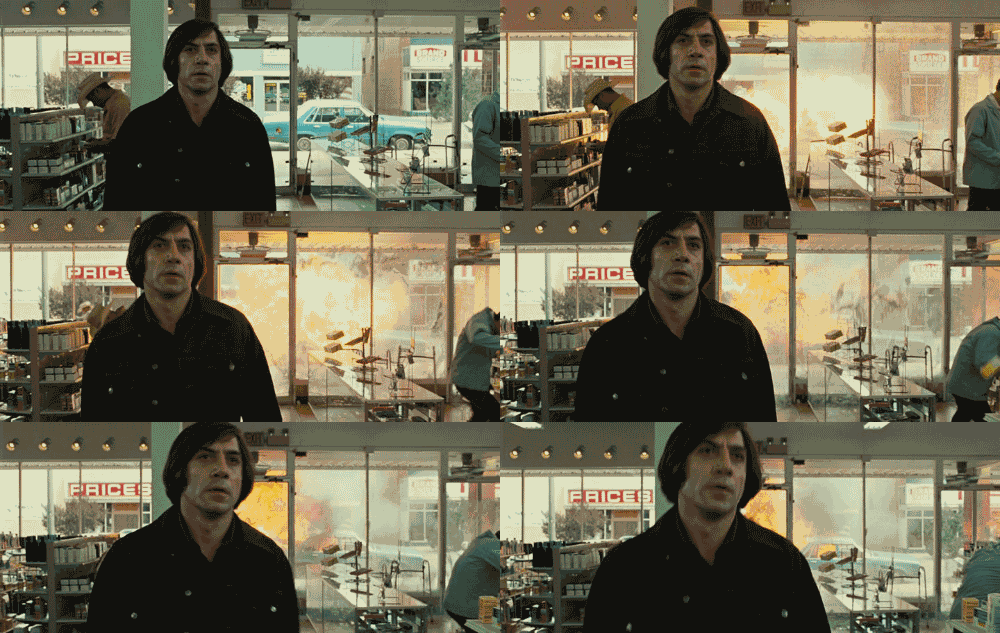
Today in class we continued the film No Country for Old Men. We picked up at an intense scene between Chigurh and Moss battling it out. When Moss tried to make a run for it by hitch hiking, Chigurh stopped him dead in his trails by killing the driver of the car. Chigurh ends up getting shot in the leg by Moss and gets away alive. The film then shows (in gruesome detail) how Chigurh cleans out the wound after stealing medication from a pharmacy by blowing up a car outside. This helps characterize how tough and heartless Chigurh is by showing how easily he handles the pain of cleaning this wound. Moss then is determined to kill this merciless killer when he sees a threat to his wife which shows Moss's companionate and protective time when it comes to the ones he loves. Yet, things take a turn for the worst. We ended our day at a very low point in the movie where the sheriff finds Moss, along with a few others, dead at a hotel. In the scene three men are scene rushing out of the hotel in a pick up truck carrying guns. The sheriff quickly pulls into the hotel to find chaos and Moss shot dead. This opened my eyes to how brutal people can be over something as simple as money. All this death in the movie was all over one brief case that contained a huge amount of cash. A once normal and innocent man was dragged into the horror of death all due to greed and drugs.
This film causes the viewer to be tense throughout the movie, while occasionally throwing in a scene here and there for comic relief. This is seen right after the intense scene of Chigurh and Moss's battle. A mariachi band is playing to Moss, who is covered in blood, a very cheerful and happy song which is ironic to the viewer. So far this movie is very entertaining and intriguing to watch and always keeps the viewer on their toes. This film has helped me also improve my skill at the use of mise-en-scene. I am able to watch this movie and notice what the film makes me feel and why it makes me feel this way. In the picture of Moss below it makes you feel anxious to know if he killed Chigurh or not. The blood and focus on one single character helps emphasize the danger of the situation,

Image resultImage result for chigurh gif

Friday, September 23, 2016

9/23/16 - Andrew Dalmedo

Today in class, we continued to watch No Country for Old Men. We picked up at the, “Regal Hotel,” with Chigurh pulling into the parking lot on account for his now actively beeping tracker. He carefully drove by each and every single one of the apartments, his tracker continuing to beep quicker and quicker; that is, until he went past room 138. Indicating that the signal was getting weaker, the beeping slowed. Realizing this, Chigurh stopped his truck and put it into reverse, slowly rolling backwards. The beeping steadily got quicker, and it eventually reached it’s peak when Chigurh stopped outside room 138. As he stared out the car window into the darkened room, the scene ends with his car’s reflection in the room’s window remaining still outside of the room, as if he’s waiting for something.

This entire scene’s purpose is to create tension and suspense, as it’s leading up to the events that will play out later in the film. The pacing is slow enough to create a lot of tension, comparable to it being the “calm before the storm.” It creates suspense through Chigurh’s personality alone, his character being a clever combination of psychopathic and collected, as if it was just another “day at the office.” The drawn curtains over the room’s window alludes to something being extremely secretive which Chigurh visually picks up on (the viewer knows that the case full of money is in that room; in other words, it’s dramatic irony).

Thursday, September 22, 2016

9/22/16 - Kada Cernek

We started off class today by discussing the likes and dislikes of our summer reading book chats. We discussed the topic of book chat size a lot. Some people in the classroom felt as though their group was too big and therefore ineffective in having a quality discussion on the book. However, some people thought their group was too small and found it very hard to hold a conversation. I personally had a book chat of 96 people for the book Me Before You. I found the large group to be very effective as a lot of ideas were thrown around and there was never a lull in conversation. The class also unanimously decided that the book chat should not be graded. Then, we started the film No Country For Old Men. We watched about 25 minutes of the movie and got a great deal of plot and setting. The movie started yesterday with Chigurh murdering two people within the first two scenes of the movie. Today we watched Chigurh kill two more people. We also saw a scene where he interacted with a man running the gas station. This scene taught us a lot about Chigurh's character but also left the viewers curious and unsettled. Personally, I found myself very confused and uneasy after the scene had ended, to the point where I turned to Mr. Rivers and said "I have no idea what just happened." Mr. Rivers said we would discuss that scene at a later date and analyze why Chigurh acted the way he did and also why the director chose the choices he did such as having Chigurh speak in such a monotone voice, or how the coin came into play. Also in the film today, we met Llewelyn Moss, another main character. Moss was out hunting when he unfortunately came across the after math of a drug deal. Moss's curiosity got the worst of him and led him to become involved in the situation by taking a briefcase of cash that he finds. Eventually Chigurh picks up on his trail, which I'm sure will not end well, however, we stopped the film there for the day. At the end of today's viewing, we were told to make one strong sentence on any content from the first 25 minutes of the movie. We were told to use our active verbs and narrow ourselves in on one piece of content. I made my sentence about the silence used throughout the film to create suspense and uneasiness. Also, it forces the viewer to rely on their visuals rather relying on dialogue to answer their questions. So far, this film has me unsettled and feeling very lost. I am not a fan, but hopefully I can be persuaded by the end of the movie.

Wednesday, September 21, 2016

9/21/16 - Michelle Cella

In class today, Mr. Rivers started the class off by asking us what intertextuality meant. The definition of intertexuality is the relationship between literary texts. After the class discussed the meaning of intertexuality, Mr. Rivers played the first four minutes of the film, No Country For Old Men. Before we started the movie, Mr. Rivers divided the class in half to analyze the film. One side evaluated the similarities of the book and the movie, and the other side evaluated the differences. The purpose of this was to eventually write intertexuality sentences between the book and the movie. (We read the first four pages of the book yesterday in class.) After watching the beginning clip of the movie, we had to write our intertexuality sentences with our group, and post them on google classroom. My group had to find the differences between the text and the film. Our sentence(s) were,“The intertextuality in No Country For Old Men, is the contrast between the novel and the film as shown in the main character's name. In the novel, he is given the name Chigurh, however, in the film he is not given a name. This choice creates suspense and mystery within both the plot and character.” Some similarities the class examined between the book and the movie, was the Sheriff’s opening monologue about the young boy and Chigurh’s murderous actions. For me, I’m not a huge fan of murder/suspense novels/films. The first four minutes of the film are very graphic, but it wasn’t too bad to watch. However, the film and the book demonstrates the perfect meaning of intertexuality, which was the lesson of class today.Reading the text and now having seen the beginning of the film, help me understand and analyze intertexuality between novels and films a lot better.
The character Chigurh from No Country for Old Men

Tuesday, September 20, 2016

9/20/16 Blog #1:Kirk Brown

At the start of class Mr.Rivers put the word Intertextuality up on
the board.  So after talking in our groups to figure out the meaning (Or just looking up the definition on google). We broke the word down into it’s roots.
We broke down the word down into 3 parts inter which we said means inside or between like in interstellar intertwine , text which represents words and in this case mostly literature, and uality that shows it's a noun. So we determined the definition is "how different text relate to one another." After doing that we went back to chart that asks what film and literature do and how they do it. We already learned the how for film Mise-en-scene Is how something is done so now we are trying to see the "how" in literature, so we read the first 2 chapter of No Country for Old Men, and then were to answer the questions What is it doing? How is it doing it? We read the first chapter as a class, this chapter was told from the first person perspective of the sheriff, then we read the 2nd chapter aloud in our own groups and used this to answer the question. My group made two sentences one of my group's answer were: The 2nd chapter of No Country for old men develops Chigurh by demonstrating his murderous actions and displays his ruthlessness by showing the uncaring reaction he has to the killing of multiple men in very violent ways. This is shown when he makes the comment "I just didn't want you to get blood on the car". Showing the ruthlessness or demonstrating the murderous actions of Chigurh is what the text is showing, and the book uses his brutal way of killing and his comments to add to the character development of Chigurh himself.

Monday, September 19, 2016

9/19/16 Blog - Michelle Cella

9/19/16

In class today, Mr. Rivers had us divided up into six groups of three, where we presented a total of three slides from our mise-en-scene projects. For instance, my mise-en-scene group project mainly focused on The Martian. I discussed and analyzed the following slides - dominant feature, lighting key, and shot angle. My other group members, Michaela K and Mike R, analyzed their projects. Michaela presented Wolf on Wall Street, and Mike R presented Room. After each person in class presented their three slides, Mr. Rivers pulled the class into a group discussion/analysis of different scenes from the show, Breaking Bad, and the movie blockbuster Star Wars. Mr. Rivers used a screenshot from the Breaking Bad baseline (shown below), where the class analyzed what elements were occurring within the shot. I mentioned the juxtaposition between the lighting and the character, Walter White, (who is pants less and holding a loaded gun). This scene exemplifies juxtaposition because, the lighting is cheery and bright, and then Walter is standing in the middle of the road waiting to commit murder. We also discussed how it may look like Walter might not belong in the scene, but he actually does. This is where color value played a significant role in the scene. His green shirt aligns with the grass, his white/blue underwear aligns with the sky, and his skin color aligns with the sand on the ground. The class moved on to dissecting two scenes from the opening of Star Wars (shown below). The first scene demonstrated depth of field, this particular scene was in shallow focus. This means only two planes are in focus, i.e., the Earth, and the little space ship. The second scene demonstrated dominant feature, because now the only thing the audience is drawn to is this huge space ship. This class period focused on establishing a better understanding of film analysis and how it applies to the scene that's given to the class/student.

Breaking Bad
Star Wars - first scene
Star Wars - second scene

Sample Blog- Zach Herbert

September 19th

Today, to start off class, Mr. Rivers spilt each table up into many different groups to chat with each other about their use of mies-en-scene in the screenshot we chose.  In my group, consisting of Mike L, Bethann, and Jake, we were able to get through Mike's entire slideshow of how his group found the specific parts of mies-en-scene.  Half way through my presentation, Mr. Rivers said that we do not have enough time to do all of each others full presentations, so Bethann and Jake were only able to do a few of their slides.
The reason why not everyone could finish their presentations was because Mr. Rivers wanted to find the parts of mies-en-scene with the whole class.  He pulled up a screenshot from the scene from Breaking Bad that was used on our baseline (shown below). With the class we discussed some of the elements such as, the composition which os the way the lines in the frame are moving.  In this case it is horizontal because of the rocky mountains in the background, the landscape itself, and the sky.  When we finished that, we had like seven minutes left in class and Mr. Rivers showed us a clip from the beginning of Star Wars.  We analyzed what the approach of the Star Destroyer creates (shown below).


Sample Blog- Jackie Dowd

September 19th
Today in class we worked in groups to discuss mise-en-scene. While discussing these different movie scenes we pointed out things like depth of field, character placement and screen density. We then continued to discuss these ideas as a class using a scene from Breaking Bad. The picture we viewed is attached below.
We went over how the colors he is wearing are also found in the desert surrounding him. This shows how even though he does not belong here, told by the fact that he is without pants, in some ways he does in fact belong. The lines are also very horizontal in this frame as seen by the sky and mountains. This class period helped to strengthen the students skill at pointing out these different elements of the film in order to develop a better understanding.

Our Class Blog

Hey, Gang!

Welcome to our class blog. I realize that it looks pretty empty right now, but that's where YOU come in! You will be responsible for filling this blog with quality writing! Someone in our class will be responsible for posting a blog by 10pm EACH NIGHT! 

A Quality Blog...

  • Reflects on the work that we have done in class that day (including objectives and inquiries)
  • Uses titles, paragraphs, and stylistic choices to compose a clear and specific account of our day
  • Draws in SPECIFIC examples from individual experiences/activities (including your first name and last intial (e.g. Bilbo B.) 
  • Includes some form of media (image, YouTube video, etc.) that connects to what we talked about in class

FINE PRINT:
Your blogging will make up your entire homework grade. Each post will be worth 5 points for its ability to accomplish the objectives above. Blogs posted after 10pm on the day they are due will lose 1 point, and after midnight they will lose 2. Please be proactive with the schedule; if you have to work on Thursday and are scheduled to post on Thursday, then talk to another student (AND ME) about switching spots on the official calendar. Please make sure that you post in the proper class. Don't forget to click PUBLISH!


To login and post your blog, follow the instructions on the YouTube Video.