Monday, October 31, 2016
10/31/16 Sarah Ramos
Since today is Halloween, our class focused on horror films. Specifically, we answered the question "How do the films create a sense of terror?" As someone who hates scary movies this class was probably less fun for me than it was for some of my horror loving classmates. Nonetheless, it was still a pretty cool topic. We discussed how horror films use long drawn out scenes and slow pacing to build suspense (usually leading up to a jump scare). We also talked about how this can be done with audio. Many of the films we watched used silence as a way of building suspense. Another way horror films create a sense of terror is by obscuring what the viewer can see in each shot. This is usually done with different camera angles which only provide a limited view. Many of the films also used darkness and dim lighting to create a similar effect. Noticing things like this gave me a new respect for scary movies.


Sunday, October 30, 2016
10/27/16 BethAnn Putnam

Friday, October 28, 2016
blog 10/27 annie monroe
Annie Monroe
Mr.rivers
English film is lit
10/27/16
- Hello! Today in class we continued watching wall-E. Wall E is about earth in the future, it shows a large amount of destruction that has taken place. Although just a fictional movie, the plot is not so unrealistic, it showed how the future of mankind will abandon earth because it has become covered with trash from people and the pollution people have caused. WALL-E, a garbage collecting robot has been left to clean up the mess. Another robot named Eve was then sent to Earth by humans to find proof that life is can be sustained on earth once again. During this time period Wall E falls in love with Eve. a big turning point in the movie is when Wall E rescues Eve from a dust storm and shows her a living plant he found in all the garbage on earth. Eve has a "directive", do to this Eve has to take the plant and automatically shuts down, and wall e becomes very sad while trying to wake eve.. Wall E, doesn't understand what has happened to his new friend, he protects her from wind, rain, and lightning, even as she is unresponsive. After a few days the massive ship comes back once again to take Eve, but Wall E, in fear of losing his love, sneaks onto the ship with eve. The ship arrives back at a large space cruise ship, which is carrying all of the humans who evacuated Earth around 700 years earlier. The people of Earth are riding around this in somewhat of a space resort on chairs that hover over the ground , this gives them 24/7 TV and video chatting. They drink all of their meals through a straw out of laziness and they’ve had a great deal of bone loss, and are all so fat that they can barely move. When the plant is given to the captain of the ship, the robot try to get rid of it because they do not want to return to earth.
- This movie so far is starting to reflect on the real earth's habits. It is foreshadowing earth's current issue and is acting as a call to action. If earth can fix its issues now then maybe we won't have to go through issues like wall e.
- Also throughout this movie, you can try making connection to the book we are reading ready player one.
Thursday, October 27, 2016
Drew Vreeland
In today's class, we resumed watching Wall-E for a majority of the class. Mr. Rivers explained once more we were to create a proper question that invoked in-depth analysis and strayed away from basic, opinionated answers. He also mentioned that as each day the class forms a new question, it should be a better question than that was asked on the first day. After Mr. Rivers finished explaining what we were to do during the film, the class watched the second third of Wall-E. It started with Wall-E returning to his manual basics of compacting trash once Eve went into a deactivated state after she obtained a plant. In the midst of doing his duties, Wall-E had to race back to Eve since a spaceship came to collect her and her newly acquired plant. As Wall-E raced to get her, he jumped onto the spaceship and traveled back to the human spaceship.

In this time, the audience was treated to glorious shots of space and discovered where humanity went. Ultimately, Wall-E follows Eve throughout the spaceship once they both enter. Eve is taken to the captain's quarters once it is discovered she holds a sign of life from the destructed Earth. From there, the portrayal of lazy humans that have grown fat and stupid become apparent and that robots run the ship. After this, it is discovered that Eve's collection of a plant seems to be a false alarm. Then, Wall-E and Eve travel the ship and space avoiding other robots that seek to fix them even though they do not need to be fixed.

Class ultimately ended when the plant Wall-E and Eve brought to the spaceship is confirmed to be a successful sign of life. Tomorrow will pick up where the class left off and finish Wall-E.
Wednesday, October 26, 2016
10/26 Bridget van Voorst

In class today we watched the first forty or so minutes of Wall-E. Along with watching the film we had to develop a specific and probing question based on the film. Before the film was turned on Mr. Rivers briefly went over what a good analytical question was composed of, stating that we should avoid opinion questions and questions that forced people to guess. We watched the film from the very beginning. As we watched the opening scene that we have seen about three times now, the animation and content were still just as pretty and intricate. Within the forty minutes of film we are introduced to Wall-E, his environment, evidence to why there are no humans and why there is so much trash, and we are introduced to Eve. Eve is a much more modern and complex robot that came on a spaceship. With little dialogue, just simple words and noises, Wall-E and Eve's love story began to unfold. When Wall-E showed Eve a plant that he had found and collected earlier that day, Eve immediately takes it, locks it within her "abdominal" area. Eve locks up and shuts down to keep the plant safe. This leads the audience to believe her purpose in coming to earth was to find any organic life. We stopped the film before any clear explanation was given, we only saw the development of Wall-E's love for Eve and his relentless effort to gain her affection. Class ended soon after the film was turned off within that time whoever did not finish their question could and tie any loose ends regarding the days assignment.


Tuesday, October 25, 2016
10/25/16 Jack Simon
Today in class we went over the podcasts that we created yesterday in class. Yesterday you and your group created their own podcast talking about the book Ready Player One and the film Wall-E. The goal of the podcast was to have a discussion with your group members about the film and book for around 10 minutes. You could either use your smart phone or a website called http://vocaroo.com to record your podcast.


The goal of today was to listen to you your groups podcast. You had about 10 minutes to listen to your podcast, that was plenty enough of time since all the podcasts did not go over 10 minutes. You could either listen to the podcast by yourself or with you group. A lot of people just listened to it by themselves because it was easier to hear. After listening to your podcast, you had to discuss it with you group. You and your group had to talk about the different qualities of the podcast and then some improvements that would have to be made on the next one. After discussing that Mr. Rivers had a class discussion with everyone about overall qualities and improvements. On one side of the white board were reasons for improvements, and on the other side of the board were good things about the podcast. Mr. Rivers would call on whoever would want to share their reason to improve and good quality about the podcast. By the end of the class, the board was filled up with improvements and qualities about everyones podcasts. Finally, by the end of class you had to go google classroom and answer the question Mr. Rivers posted. You had to list some qualities about your podcast and some improvements that you would make about your podcast.
Monday, October 24, 2016
10/24 Joe Schwab
Today in class we talked about podcasts and how we would be working on them in class. We started class by discussing how we would do the first sample podcast for Ready Player One. Mr. Rivers said over the next three weeks we would be getting together in our groups and making there, 5-10 minute podcasts about the three levels of the book. Mr. Rivers then showed us a calendar of the next month of when the podcasts where do and of when we needed our selections due for our real podcast assignment. After we went over the due dates we talked about possible ways to recording the podcasts like using Vocaroo.com, or our smart phones. 
Then as a class we watched a video of Mr. Rivers using Vacaroo.com to record the pod cast and how to save the link that the website created. Then he explained to us that what is needed to have a good quality conversations. We then were told that we were going to break u into our table groups and make a podcast on the beginning of Wall-E and Ready Player One. Then the class got to work on that with three groups going in the hall and three groups in the classroom and we started working on the questions we would ask in our podcasts to make the great conversation we were striving for. The last fifteen minutes of class was spent making our five minute podcast and putting them onto the google classroom document that Mr. Rivers had given us.
10/24- Amanda Scully
Today in class we started off by looking at a schedule that Mr. Rivers posted. The schedule contains due dates in November and December. Such due dates include, Podcasts for Ready Player One, Mini Film club chats/ podcasts, etc. You can access this schedule from google classroom, we will be using this to check due dates throughout the year.
 We then started to discuss podcasts. Today we recorded our very first podcasts within our groups! We has the option of using Vocaroo or the Voice Memos on a smart phone. The goal was to try and discuss setting or climate fiction for both Ready Player One and Wall-E. My group focused on climate fiction. We first started talking about how many authors are using climate fiction to alert the audience that the events that are happening in the book or movie may become reality in a few years. In the next ten years, probably not, but withing the next hundred years, there could definitely be a issue with climate. We then started discussing how Ready Player One and Wall-E are aimed at different audiences. Ready Player One is aimed at young teens, because of the language, characters, and the style. Wall-E is aimed towards children and adults, this may seem like a huge age gap, but it makes sense. When the movie was in theaters it is aimed at children because of the animations, but the moral of the movie is aimed at adults. This topic eventually ended our practice podcast.
At the end of class Mr. Rivers mentioned to bring head phones to class tomorrow, because we will be listening to our own podcasts, and reflecting on them, whether it be how can we make it longer, or how can we make it better.

At the end of class Mr. Rivers mentioned to bring head phones to class tomorrow, because we will be listening to our own podcasts, and reflecting on them, whether it be how can we make it longer, or how can we make it better.
Michael Mancuso - 10/24/16
Today in Mr. Rivers' class, we continued our talk about podcasts. First, we looked over our schedule for our reading and podcast due dates and then we started doing podcasts of our own. We set up our desk clumps as podcast recording stations using Vocaroo, an online voice recorder. Our objective in our preliminary podcast was to discuss the introduction to the film, Wall-E, and the book we're reading, Ready Player One, in order to form a unifying idea between the two mediums. My podcast group consisted of four members, Annie Monroe, Lauren Mitchell, Michael Loh and myself. Very nervously and somewhat regretfully we started the recorder and began our discussion. Michael Loh started us off with a brief introduction in which we stated our names and he explained what we would be discussing. The unifying idea we implemented into our discussion was setting so we started by posing a question on setting. The question was, "What suggests that the place where the narrator lives is not an ideal place?" to which Lauren responded with great detail by introducing evidence from the book. As our discussion ensued, we dove deeper into the important aspects of a effective podcast by posing new questions, and branching off of those questions to further develop the conversation. Each new question, for the most part, led to some conversation and piecing it all together added a bit more clarity by taking a broad view. Upon completing our relatively brief podcast, we reflected on what we could improve and we all agreed that we need to conduct the conversation more personably. We found that having the computers right in front of us made us sound more scripted in our discussion, however, if we set them off to the side and focused, rather, on the task at hand we might produce a better flow. Overall, today's podcast work helped fade out some of the questions we had about how to design, present, and conduct our podcasts.
Friday, October 21, 2016
Michael Loh 10/21 Plzzzzzzz Read This Friends :)
I just want to start off this blog post with a story. It starts at the very beginning of this school year. Everyone probably remembers that first day when we walked into class and all sat with our friends. We were all like "Yoo whaddup boys" or "this is gonna be such a great class" until Mr. Rivers was like "hold up fam... assigned seats". At first, it was a very sad moment. I would be separated from my beloved KJ. I said my goodbyes and then proceeded to walk over to another table with a new group of people. What I thought were initially a bunch of dweebs turned out to be a pretty awesome and sick group. There was Annie, the really funny loud person. There was Mike, the really cool dude. There was Lauren, the person I think is really smart, but I'm not entirely sure. There was me, the coolest dude in school. The last person at this table was Will. Will was a decent guy. I had 3 classes in a row with that child. I thought that this was going to be a great year. Sadly, the very next day, Will was gone. I was deeply saddened by this. I cried a lot. Not on the outside but on the inside. (I wonder if anyone has actually gotten this far). It was like our table was no longer complete. Now, there is just an empty void at our table that reminds me everyday of how we aren't a real team because one of our parts is missing. It's kinda like the saying, "You need the wheels, engine, frame, seats, and a driver to work a car". Will was like our driver. Without him, I feel as though I really have no direction anymore. jk lol.
Okay.... so in class today, we were supposed to read an article and write about stuff. I think we were supposed to write something about Wall E and Ready Player One. To be completely honest, I haven't really started it yet, but let's keep that a secret. I'm just spending my time writing my blog. I'll probably get that stuff done after I finish this. Also, for anyone that wasn't here today, it's ok because Mr. Rivers isn't here either. Our sub took attendance and is kinda just sitting in the corner doing nothing. That's ok though. So today is basically a pretty chill day.
I really want to emphasize how much I actually miss Mr. Rivers. I'm not trying to kiss butt. I really mean it. He has been my favorite English teacher so far. I've kinda had some not so helpful English teachers. I don't want to mention any names but **cough** Barker **cough**. What... nothing. Yup. But for real though, he's actually like... really hyper in the mornings. It's actually a really nice wake up in the mornings.
Yea... I don't really have anything left to write about so..... bye.
Love
Michael Loh<3
Thursday, October 20, 2016
10/20/16 Brooke Rossiter
Today, the objective of the class was "IWBAT evaluate a discussion question's ability to probe evidence. IWBAT craft a strong discussion question based on a unifying idea." We then started the class by looking at the "good" and "bad" questions that the class created on Tuesday. We discussed that good questions contain open-ended inferences, are very specific to a part of the text or evidence, go beyond right and wrong and require analysis over opinion. We also discussed that bad question are not based on evidence, have open-ended guesses, obscure the real questions and are not specific. We then were given three questions from Mr. Rivers and were told to rate them from the best to worst. After ranking them with our groups, we were given two minutes for each question to try to answer the questions, which made us re-think our original ratings. My group and the whole class came to an agreement that the first question was the best, due to it's specificity, evidence from a certain scene, and ability to come up with more questions. After this, Mr. Rivers gave the class an assignment on Google Classroom to come up with a "good" question from the reading of chapters 0-1 in Ready Player One. This is good practice to understand the difference between good and bad questions.
Chris Link 10/20
On Thursday the twentieth of October in the year 2016, we walked into class and were as usual greeted by Mr. Rivers. Our table first discussd who had actually read the book, and unsurprisingly most of us had. Mr. Rivers then proceeded to commend us for having made good responses to the question he posed on Tuesday that being, "Make ONE of your questions as bad as possible. Post it here. Make AT LEAST ONE of your questions as strong as possible. Post it here too." After this we looked at three questions, telling us to number them 1-3 in regards to how god of a discussion question they were. We took two minutes to discuss each question, the whole time Mr. Rivers would walk around listening to the discussions we were having and prompting us to go back to the Wall-E video clip to find evidence. The first question was the best discussion question because it allowed for many different interpretations of the same choice in the film, as well as having those interpretations be backed up by particular implications in the clip. The second and third questions were both terrible because they stimulated only wild speculation that could not be reasonably backed up by any events in the clip. We then talked about what good and bad discussion questions do. These are the notes i took for this part of the class, "Things that good questions do
Open ended, inferences, specific, encourages open thinking, goes beyond right and wrong
Things that bad questions do,
Not based in evidence, speculations/ guesses, obscure/cover up real question" To beat the dead horse even more, he then pulled up a page with many of the good and bad questions that were posted on Tuesday. By far the best terrible question was , "What was that thing?" This question elegantly throws specificity and clarity out the window, making way for confusion and befuddlement. The following picture depicts a group of people most likely having a good discussion, of course having been prompted by an exceptional discussion question first. We ended the class by revising our good sentences from Tuesday.

10/20/16 Nina Levatino
Today, the objective of the class was as follows; "IWBAT evaluate a discussion question’s ability to probe evidence. IWBAT craft a strong discussion question based on a unifying idea".We then expanded on these ideas by beginning with an activity where we would look at the "good" and the "bad" questions we made with our groups the day prior. Good questions consists of open ended inferences, specificity in reference to a part of the text (evidence), focus on analysis answers in contrast to opinionated answers, and good word choice. Bad questions consisted of questions not based on evidence, with a "yes" or "no" answer, that obscure the real questions, and lack of specificity. Mr. Rivers then gave us 3 questions and told us to rate them as best to worst. Then we were told to actually answer those questions and re-evaluate our initial ratings. We were given two minutes to answer each. Our group had the best conversation with the third question, but came to the conclusion that the first was the best. It was specific, had the ability to incorporate evidence, and had good word choices. At the end of the period, we were introduced to a homework assignment involving our first in-class book, Ready Player One. The idea was to come up with specific textual evidence and base one GOOD question off of it. All of this plays back to the idea of podcasts. We are thinking of GOOD and BAD questions in preparation for our student-created podcasts. We need to know which questions will provoke thoughtful and entertaining answers, rather than dull and spineless.


Tuesday, October 18, 2016
10/18/16 Sarah Ramos
Today in class our main objective was to interrogate a text to provide strong discussion questions and then evaluate the quality of a text based question. When we did this we used a combination of text and film. First we analyzed how questions "propel conversations by posing and responding to questions that probe reasoning and evidence; ensure a hearing for a full range of positions on a topic or issue; clarify, verify, or challenge ideas and conclusions; and promote divergent and creative perspectives." With the unifying idea being questions, the class used this sentence to come to the conclusion that questions lead to new ideas and conversation. We also decided that a good detailed question should be answered with reasoning and evidence. A good question should encourage interpretation and balance specificity and clarity. We then watched the first scene of Wall-E.
From this film clip, each group had to come up with a questions using each interrogative adverb. My group came up with the sentences "Who is the story about? What caused the area to look like this? Where did the garbage come from? When is this taking place? Why is Wall E building up garbage piles? How long has he been doing this?" Then we had to post one bad sentence and as many one to five good sentences. My bad sentence was "what year is it?" This is a bad sentence because it is too specific to answer or discuss and there is no room for interpretation. My good sentences were "Why is Wall E building up garbage piles? How long has Wall E been building up garbage piles? Who else is on the planet helping him?" These are good sentences because they can be answered using reasoning and evidence. They also can be discussed as people may have their own interpretation and unique answer.
10/18/16 Jake Lepore
Today the main lesson is to interrogate a text to provide strong discussion question, and evaluate the quality of a text based question. Before we started to go over those lessons Mr. Rivers then assigned us homework to read chapters 0-1 in Ready Player One. For a few minutes he talked about how he likes the book but we don't have to, which I appreciated because I don't like it when a teacher loves a book and when we didn't, they would get into a fuss. Also a reminder to think about the groups, movies and book we have to choose for our podcast by November 9th. The first unifying idea for our podcasts is setting. We were given a goal for today which was a very long question which can be found on google classroom. In our groups, we split the question up into three part and figured out what section meant. For example my section was B which is, "Ensure a hearing for a full range of positions on a topic or issue." What we came up was to not be bias. Instead we need to show all sides of the arguments, while explaining we are telling someone something not trying to persuade them. After the individual group discussion we all came back together to dissect each section. Then we were given a movie clip, (see link below) in our groups we worked together to make questions in the 6 points, those being who, what, where, when, why, and how. We made rough drafts of our questions, then we posted out worst question and our strongest question and posted it on the classroom. Our bad question was, "Why is the earth so dirty?" and our better question "What does it show that the character is listening to this kind of music."
https://www.youtube.com/watch?v=nLx_7wEmwms
https://www.youtube.com/watch?v=nLx_7wEmwms
Monday, October 17, 2016
10/17/16- Ben Lee
Today in class, we started out with talking about the podcasts we listened to with our tables. It was interesting to hear about the different ones people chose to listen to, one person just listened to a podcast where people just had conversations for two and half hours. Others listened to political shows, some listened to informational ones, but most seemed to follow a certain theme. They mostly had a topic that was the central idea for the entire show, and for the most part the shows seemed unscripted, with a conversational feel. The people hosting these shows would laugh, go off into small anecdotes, and generally just have a good dialogue that flowed smoothly.

We then talked about the group project that we would be doing over the next four weeks. As a group of up to five people, you would choose four films and one book to watch and read. They all have to have a central theme about them however, from genre to an idea that the texts share. This all was a part of a bigger and goal, where the group would eventually have to make their own podcast about the texts they used. The good news is that the first one we do won't be graded. Mr Rivers gave us a book as for the first podcast, Ready Player One, which looks like an interesting book to start with.
10/17 - Sarah Hoffman
Today in class we talked about the podcasts we listened to over the weekend. I listened to Welcome to Nightvale, a fictional podcast about a mysterious small town. We talked about what the medium of a podcast meant to our stories as opposed to a film. In my case, it puts you in the mysterious town of Nightvale as you listen to Cecil Baldwin's radio broadcast about the events in this mysterious place. This story could not be told in the effective and unique way that it is told using a visual medium. We then discussed a project that we will do involving making a podcast. It will be analytical of four films and one book sharing a unique theme or genre. We will do these "mini film clubs" many times during the year. However, we will begin by using Ready Player One, the book we received in class today, to conduct a class version of this assignment.
Below is a link to the first episode of Welcome to Nightvale. All of their other episodes are on YouTube as well. I highly recommend it, although it is a little....weird.
Below is a link to the first episode of Welcome to Nightvale. All of their other episodes are on YouTube as well. I highly recommend it, although it is a little....weird.
Friday, October 14, 2016
10/14 Michaela Kayal
Today in class our objectives were, I will be able to evaluate the product of my own writing, reflect on my writing process, and to find and listen to a podcast that I might enjoy. Mr. Rivers informed us on the differences between high water writing and low water writing. High water is the best parts of a person's writing, for example the highlights and strong content in an essay. Low water are the parts that could use editing and improvement. After this lesson, we had to unsubmit our essays and edit and leave comments. We had to comment and create ten sentences on the following topics: Content, organization, voice and style, presentation, and research and citation. We had to go through and reread our essays and try to find the ares where we succeed and where we need improvement within those topics. For example, for content check to see if you thoroughly analyzed the evidence to draw a clear connection back to your topic sentences. Or to make sure that the heading was correct and the citations were in MLA format. Activities like these are essential when figuring out how to improve your writing. Additionally, we have homework to watch a podcast. The assignment is,"Which podcast did you listen to? How is your podcast different from a film? Did you enjoy this podcast? Why or why not?"Personally, I am going to find a podcast about a TV show I enjoy or maybe even a one about the election.

Today in class our objectives were, I will be able to evaluate the product of my own writing, reflect on my writing process, and to find and listen to a podcast that I might enjoy. Mr. Rivers informed us on the differences between high water writing and low water writing. High water is the best parts of a person's writing, for example the highlights and strong content in an essay. Low water are the parts that could use editing and improvement. After this lesson, we had to unsubmit our essays and edit and leave comments. We had to comment and create ten sentences on the following topics: Content, organization, voice and style, presentation, and research and citation. We had to go through and reread our essays and try to find the ares where we succeed and where we need improvement within those topics. For example, for content check to see if you thoroughly analyzed the evidence to draw a clear connection back to your topic sentences. Or to make sure that the heading was correct and the citations were in MLA format. Activities like these are essential when figuring out how to improve your writing. Additionally, we have homework to watch a podcast. The assignment is,"Which podcast did you listen to? How is your podcast different from a film? Did you enjoy this podcast? Why or why not?"Personally, I am going to find a podcast about a TV show I enjoy or maybe even a one about the election.
Thursday, October 13, 2016
10/13 Lauren Mitchell
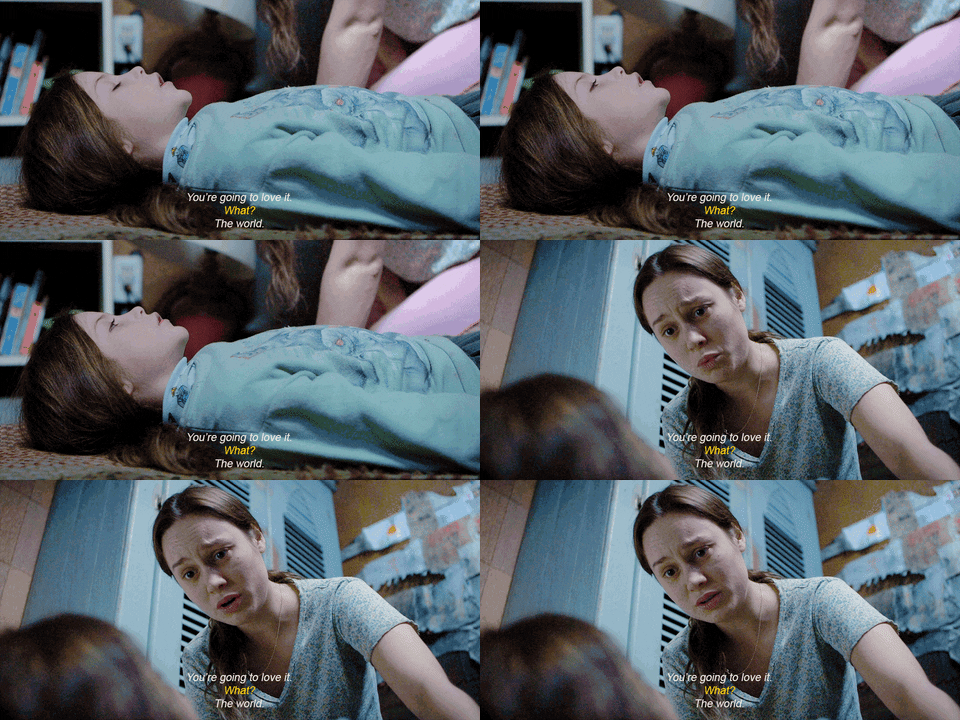
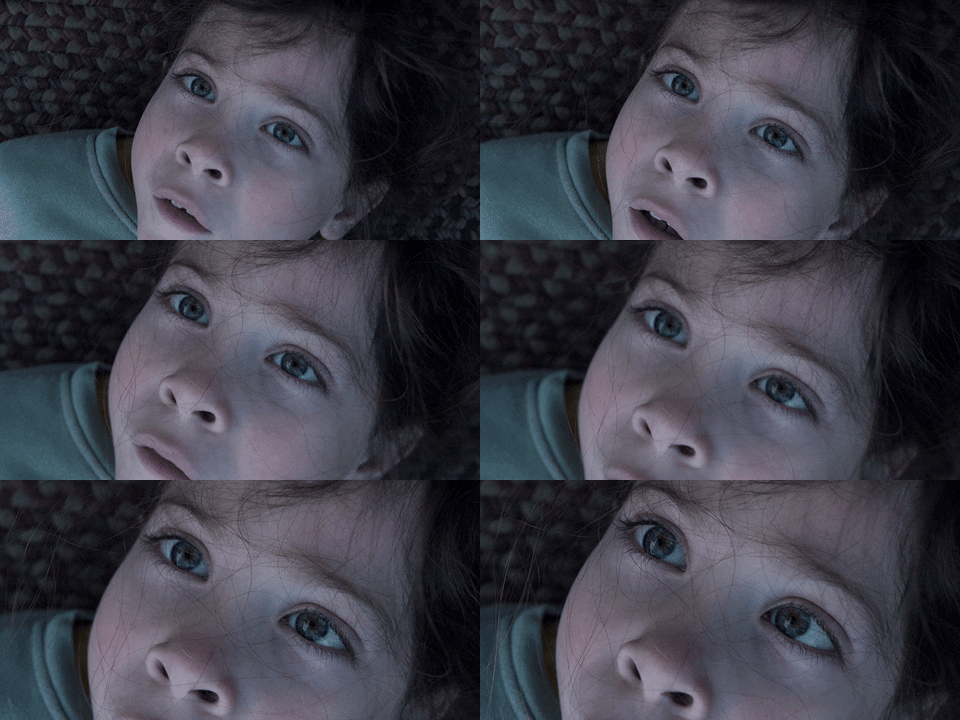
Today, October 13, the focus of our class was on finishing up and interrogating our intertextuality essays, as they are due tonight. Mr. Rivers stressed how important it is to ask questions about our essays in order to make them the best they can be. In the time we had to work on these essays in class, many of us used this idea of interrogation to ask ourselves, "How well does my essay use specific evidence... stay on topic... draw clear connections..." These questions were asked for the content, organization, voice and style, presentation, and research and citation aspects of the paper. Once going through this process, many of us starting to think about titles for our papers. Interesting titles, not just "My Intertextuality Essay". The examples shown to us gave us ideas to stir from in order to create an original, creative title that would start off the paper on a good note and capture the reader's attention. Mr. Rivers also include some sample senior papers for us to use as resources. In these essays written by previous students, there are components of their papers that make them well written. These helped us shape our essays in a similar well written fashion. My film and novel I wrote about is Room written by Emma Donaghue. I used today to proofread and interrogate my essay in order to get the grade I am looking for. I was able to completely finish my essay today and ask questions that helped me improve my paper. I can now say that I am feeling good about my essay and have included everything Mr. Rivers is looking for. Therefore, class was very productive and helped my classmates and me finish our first film as literature essay.


Wednesday, October 12, 2016
October 11 - Michael Mancuso
On October 11, we gathered as somewhat of small class as opposed to our normally full class because today was senior skip day. Half assembled, we continued our work on our intertextuality essays. Some worked on outlines, some developed strong thesis statements and topic sentences, and many continued to type their essays. Additionally, nearing the due date, some of us started peer editing or even had Mr. Rivers review our papers. In my desk clump, Michael Loh, Annie Monroe, Chris Link, and I worked with each other swapping computers to review one another's papers. Chris and I swapped first and I read over his thesis statement and topic sentences. I thought they were very strong and resembled flawlessly the idea of developing a balance between clarity and specificity. I then traded with Michael Loh to review his paper. I thought his paper was well written and detailed but I made one suggestion; to vary his syntax and sentence structure to improve the flow of his writing. Then, I looked over Annie's outline, thesis statement, and topic sentences. I thought she had everything well organized and her thesis statement and topic sentences also displayed a good balance between clarity and specificity. Finally, I looked over my paper which the other three in my group had made suggestions for edits. I found that in some sentences I added too much detail which took away from the clarity of my sentences. I revised my sentences to regain that coveted balance, once more, or clarity and specificity. With the help from my classmates my essay on Captain Phillips is developing into what I think is a very strong paper. Overall, while today was a strange day, having only half the class present, it was a very productive day.

Tuesday, October 11, 2016
Michael Loh 10/7
It was like any other day in this strange English class. As I walk into class, I'm greeted by an overexcited Mr. Rivers at the door. We always say good morning to each other. I don't really know if that is a special thing between us or if he does that with everyone, but I really enjoy it. Some might see his energy as strange, but I find it very refreshing in my mornings. It really wakes me up and gets me ready for the rest of the day. You can never really fall asleep in that class. One of the things we did in class was talk about specificity and clarity. There was a picture of Michael Scott from the office on the board. We used that as a starting point for our lesson on specificity and clarity. After we finished going over that, we watched a clip from the office. It was a funny scene where Michael Scott hits a lady and does a bad job of retelling what happened back to his colleagues. We used this scene to describe specificity and clarity. We as a class decided that in that scene, Michael was being specific, but not clear as to who hit the lady. Michael described everything that happened while trying to avoid saying that he was the one that hit the lady. The lesson to take away from this is that you want to maintain a balance between being specific and being clear. While we were watching The Office, I also was working on my intertextuality essay. I mean like... it's due really soon and I needed to work on it. I feel like other people were in a similar situation to me. It seemed that many people found that class to be very entertaining.
10/11 Connor Erickson
Today in class we continued working on our intertextuality essays. Some students were drafting their essays while others were finding evidence to integrate in their essays. There were more absences than usual so we worked on our essays the whole entire class period. My essay is on the differences between the movie, Captain Phillips, and the book, A Captain's Duty. My group talked a little bit at the beginning of class about where everyone is in their drafting process. Zach is doing his essay on the movie and book Money ball, and then Jackie and Lauren are doing their essays on the movie and book, Room. Zach is in the same stage of drafting as I am. We both wrote our thesis statement, topic sentences, and found evidence for each body paragraph. Now all we have to do is actually write the essay. Lauren and Jackie are a little further ahead because they already wrote their topic sentences, thesis statement, and found evidence and now they're in the drafting stage. After talking a little bit at the beginning of class about what stage we were in, everyone got to work.
The main differences that I'm focusing on for my essay are the character of Captain Phillips, the point of view that the story is told from, and the emotions of Captain Phillip's family. The movie and the book has a lot of scenes that are not exactly similar but that's because the author and director may have different tastes. Hollywood needs to change the scenes in order to make a movie a blockbuster hit so that wasn't really surprising. What was surprising was the difference in the way Captain Phillips acts, how first person is told in the novel and third person in the movie, and how the family is included in the novel but not so much in the book. Now that I have my evidence and topic sentences, drafting the essay will be a lot easier.


The main differences that I'm focusing on for my essay are the character of Captain Phillips, the point of view that the story is told from, and the emotions of Captain Phillip's family. The movie and the book has a lot of scenes that are not exactly similar but that's because the author and director may have different tastes. Hollywood needs to change the scenes in order to make a movie a blockbuster hit so that wasn't really surprising. What was surprising was the difference in the way Captain Phillips acts, how first person is told in the novel and third person in the movie, and how the family is included in the novel but not so much in the book. Now that I have my evidence and topic sentences, drafting the essay will be a lot easier.


Friday, October 7, 2016
Chris Link 10/6
As I entered the classroom on October the seventh, of the year two thousand sixteen, I was greeted by Mr. Rivers by the door as he does everyday. The classroom was extremely cold at first, and I distinctly remember someone inquiring as to why this was, to which Mr. Rivers responded, "When I walked in here this morning they were pumping cold air in through the vents." I then proceeded to walk to my desk, and was not at all surprised to see that my laptop was not there because it was plugged in at one of the many charging stations. After searching every station that didn't have my laptop I finally found it at the last one. Knowing I had to write a blog today I pulled up my class notes page and wrote down all of these preceding events before I could forget them. Once the bell rang to signal the start of the period, Mr. Rivers strolled in and casually announced that we would be revisiting the topic of crafting our essays today. Immediately following that he posted the class ID and password for turnitin.com on his google classroom page, so that everyone could join and make sure that turnitin was working for them. Turnitin.com of course being a website where students can submit their essay's and have the site's software scour the paper for any plagiarized works. Once we had all signed up for turnitin he posted another assignment on google classroom. This one asked us to explain our goal for not only that class period but for the rest of the week as well in regards to the formation of our essays.

I answered this question by stating that I was planning to work on my topic sentences for my essay, and if there was time I would formulate a thesis. We then proceeded to work on our essay's according to the plan we had just set up. Mr. Rivers emphasized that this time should be used to work on the essay and not to finish reading or watching the movie that you had chosen. At the end of the class he asked us to update our response from before to see to what extent we completed our goals for ourselves.
Thursday, October 6, 2016
Jackie Dowd- October 6
In class today we started out going over a few different things for our essays that are due next week. Every member of the class had to go on Google Classroom and type a sentence about what they would like to achieve in the class that day. Also, we had to include how we plan to finish our essay over the next few days. The rest of the class period was absolutely silent as every student focused on accomplishing the goal they posted for the day. My individual goal was to finish the whole organizer that period. Both Zach and Connor focused on reading their stories to look for quotes and Sarah began to write and plan out her essay. With about five minutes left in class Mr. Rivers told everyone to go back on Google Classroom. Then, we added what we accomplished that class period and if our goal from the start of class was completed. Lucky for me mine was, besides a few quotes that I need to find from my book Room. I found many differences in the setting, characters and even story line between the book and movie that I plan to express in my essay. This project is very interesting because it helps you think about why the writer and director took different approaches to the stories rather than just huffing and puffing that your favorite scene was left out. Over all the class period was all focused on hard work and concentration.

October 5th, 2016- Nina Levatino
Today in class, we began the class with a group activity. Each group answered certain questions to the "Sample Senior Paper". This served to give us an idea on how to complete our essay with thorough analysis and an effective thesis. We had a choice of four different questions to answer. Each question brought up a topic of great discussion, some argument, and a final agreement. Our group discussed the thesis and whether or not it was effective, only to discover we've all learned how tot write a thesis differently. Michaela and I, having been in AP last year, learned to be brief but effectient in our thesis. Ben, Chris, and Jake all learned to include a preview into every topic sentence. We settled on including both opinions in our answer. We then worked on our essays. Each student had something different to complete. Some continued to read their books and look through for potential quotes. Watching movies and looking up certain scenes on YouTube was also taking place. I, myself, created an outline for my essay and finished drafting my thesis and 3 topic sentences. My essay on the film and novel, "The Godfather" discusses the crimes of the "Five Families", which is based on a true story. I found many differences in character acknowledgment and overall story line. Efficient work was completed throughout class and everyone seems to be getting a lot done.


Tuesday, October 4, 2016
10/4/16 - Kada Cernek
Today, we started off class by recapping on yesterday’s lesson of citation. We were asked what three points are always needed to integrate a quote in which we all answer Introduce, Cite, and Analyze. We talked about our essay which is due in about a week and how we are going to integrate our quotes and cite our evidence. When referencing the book, the only thing we will be able to cite is quotes since in a book there are nothing but words to quote. However, in the film we have the option to either cite quotes, which in a movie is just dialogue, or integrate mise-en-scene elements. If you talk about mise-en-scene elements within your essay, you do not need to MLA cite this as it is not a specific quote. Next, we read a sample senior paragraph on the Great Gatsby and discussed with our group what works and does not work about this paragraph. Then after grasping the concept, on our own we were told to begin incorporating this technique into our own essay. The directions were to select a point of contact in our book/film, then craft a claim and observation about this point, finally effectively integrate this evidence. The remaining 10 minutes of the class were spent working on our own personal essay and crafting different claims between our text and our films.
 I began to draft a paragraph for my essay on the major differences between the book The Martian, and the film. This is a picture from the scene where there are major intertextuality differences. In the film, Matt Damon has a smooth transition from one space vessel to the other while on the planet mars. However, in the book, Matt Damon gets into a big accident in the space rover almost causing destruction and death. Damon's space rover accident was a huge part of the story as it was that moment that created an emotional connection between the reader and the character. By not including this in the film, the plot line loses a lot.

10/4/16
Today started with Mr. Rivers talking about the questions that was asked yesterday which was, “How is your draft going? What’s standing in your way right now? How can I help you with that?”. It transitioned into a somewhat life lesson about us being responsible with our choices and how important it is to be independent with what we do. Today is another work day for starting our essays, this included analyzing and citing our books. We were also given a graphic organizer for our essays, it is optional, but I love graphic organizers so i’m going to use it. Mr. Rivers asked us what the three important parts of evidence integration (ICA). The first one is introduced, that provides context that is clear is specific. The second one is cite, that is giving credit to the person who created the work that we are using in our essay. (Introduce and cite should be in the same sentence.) The final one is analyze which connects the evidence to the claim. The only two sources we can use for our essay is the novel and the film nothing else. He also wants us to incorporate Mise-en-scene into our essay. (Surprise surprise). After all of that we were given a sample text about The Great Gatsby which can be found on google classroom. We read it out loud and analyzed it together, when we finished and explained it to Mr. Rivers he let us start the ICA process for our own novels and films.

ICA can best be described as this sushi kid. All of the pieces need to be properly put together.
ICA can best be described as this sushi kid. All of the pieces need to be properly put together.
Monday, October 3, 2016
10/3/16 Ben Lee
Today in class we learned how to effectively use evidence in an essay. Evidence is a vital part of any essay, for it provides the meat of a paragraph, something to examine and the explain your topic sentences. For our class we'll mostly use MLA format to cite any quotes we pull from the texts. With the the 8th Edition of MLA coming out the format has changed slightly, so be careful on using online sources to help you cite anything you use, it may be incorrect because of it being an older version.


MLA looks something more or less like this, with the exclusion of #4, 5, 6, and 9. The author can be exchanged for director in the case of a movie, but it must be written as "Dir. First Name Last Name." The container is what medium was used to view the text, whether it be a book, or Netflix if it was a show or movie. The publisher is the company that produced the text, such as Marvel. Simply put, whoever provided money for the book to be written or the movie to be made. It's also important to write the title correctly, with it being italicized, or underlined if handwritten. All major works should be treated this way, books, movies, magazines, even US vehicle names. Depending on what you want to focus on in your essay, the title of the text can be put in front of the author's or director's name if you want to focus on the text itself. The other way is where you focus on the Director's choices in the film, and what they could symbolize or mean.
Subscribe to:
Posts (Atom)